


Noely Mendoza brings a deeply personal and unflinching directorial voice to “Sugar Beach”, her first narrative feature film. Co-created with writer and star Zoe Manzotti, the coming-of-age drama explores polyamory, grief, queer identity, and youthful resilience with rare honesty. Drawing from her documentary roots and lived experiences, Mendoza crafts a story that feels both intimately real and cinematically alive.
Mendoza’s journey with “Sugar Beach” began in 2020 over lunch with Manzotti at Sage Cafe in Culver City. Manzotti shared the script, and Mendoza was immediately captivated by its core message: girls pursuing what they want, regardless of societal expectations. Their shared history as Amherst College classmates—where Mendoza studied documentary filmmaking with a focus on visual anthropology—laid a strong foundation of trust. After a successful proof-of-concept that toured the festival circuit, they incorporated audience feedback, raised funding, and brought the story to life in its current form. Throughout the process, Mendoza remained committed to honoring Manzotti’s vision while weaving in their mutual experiences.
As a director transitioning from documentaries, Mendoza brought an ethical, collaborative spirit to the set. She involved herself in rewrites and worked closely with the cast and crew to ensure authenticity. This approach was particularly vital when tackling sensitive themes. The film portrays a high school throuple with nuance, showing both the beauty and the real-world consequences of living outside heteronormative norms. Mendoza hopes young queer viewers especially feel seen, celebrated, and empowered. “Being queer is a beautiful thing,” she emphasizes, rejecting exploitative or sensationalized portrayals in favor of natural, loving representation.
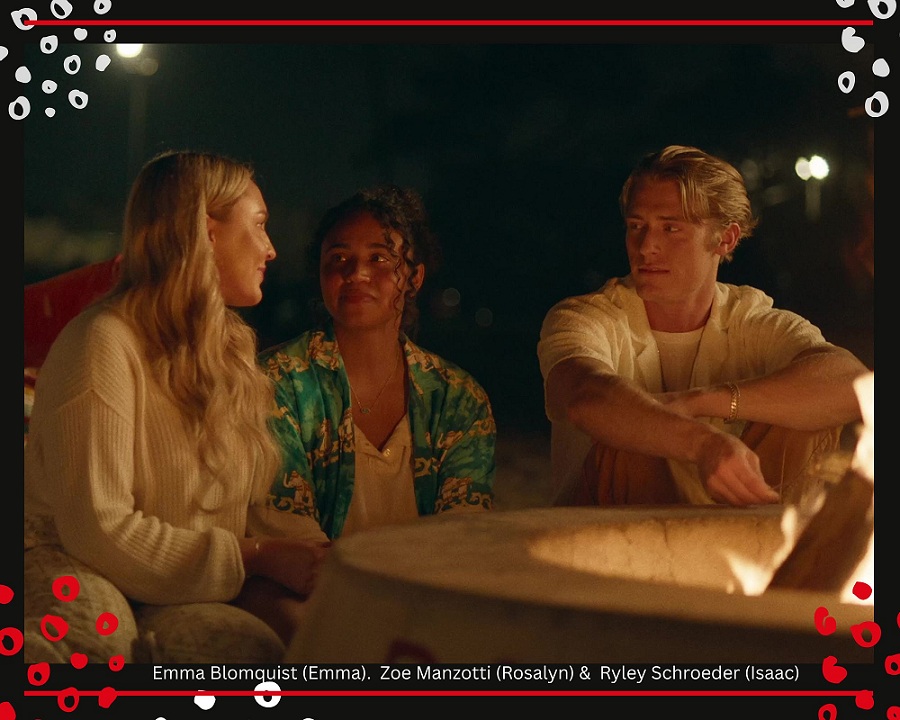
Visually and sonically, “Sugar Beach” stays grounded in reality. Mendoza collaborated closely with composer Chelsea McGough to create a minimalist score featuring strings, piano, guitar, and synths. The music balances heavy passages reflecting grief with lighter, hopeful motifs that capture teenage optimism. This emotional duality mirrors the story’s tension between loss and the excitement of impending high school graduation. Sound design and cinematography work in harmony to keep audiences immersed in the characters’ intimate world, never pulling them out of the emotional experience.
One of the film’s most distinctive elements is its foundation for a larger trilogy. While “Sugar Beach” stands strongly on its own, it plants seeds for “Blue Underwater World” and “Mudslides”. These future installments will continue following the characters through college and beyond, exploring ongoing struggles with addiction and grief. The trilogy also expands on themes of nature as a powerful, reclaiming force—deeply rooted in California’s landscape and the layered experiences of women of color.
Mendoza faced significant challenges bringing this vision to screen. As a first-time narrative director, she navigated Hollywood’s skepticism as a young filmmaker of color. Production coincided with her being seven months postpartum, adding profound personal and professional demands. What carried her through was the extraordinary trust and talent surrounding her. The core cast had lived with their characters since the proof-of-concept, and her cinematographer shared a well-established shorthand. This foundation of safety and belief allowed for raw, vulnerable performances that feel genuinely earned.
Mendoza’s personal background deeply informs the film’s tone and texture. Growing up in Santa Barbara and drawing from Manzotti’s Palos Verdes roots, she portrays coastal California communities that appear idyllic but harbor hidden pressures. Her Mexican-American heritage and Catholic school upbringing influenced the story’s moral complexities and exploration of identity. Nature itself becomes almost a character—beautiful yet unflinching—reflecting themes of colonialism, land, and resilience.
Her creative influences are equally eclectic: from experimental filmmaker Dinorah de Jesús Rodríguez and the immersive documentary “Leviathan”, to Sean Baker’s resourceful “Tangerine”, Alfonso Cuarón’s “Y Tu Mamá También”, and the emotional editing of “Eternal Sunshine of the Spotless Mind” (which inspired a memorable flashlight scene in “Sugar Beach”. These touchstones helped Mendoza blend vérité authenticity with cinematic beauty.
Through “Sugar Beach”, Noely Mendoza establishes herself as a director unafraid to tell complex, feminine-driven stories with both grit and grace. Her work invites audiences into honest conversations about queer joy, addiction, grief, and the courage to live authentically. As the first chapter of an ambitious trilogy, the film marks the beginning of a promising new voice in independent cinema—one that prioritizes truth, collaboration, and the transformative power of seeing yourself reflected on screen.
For the latest updates on streaming platforms, please visit http://www.SugarBeachMovie.com. The film is distributed by Porter + Craig Film and Media Distribution.
For interview inquiries with Noely Mendoza please contact
Sharry Flaherty
Cinema Partnerships
Porter+Craig Film & Media Distribution
partnerships@pcfilmandmedia.com