

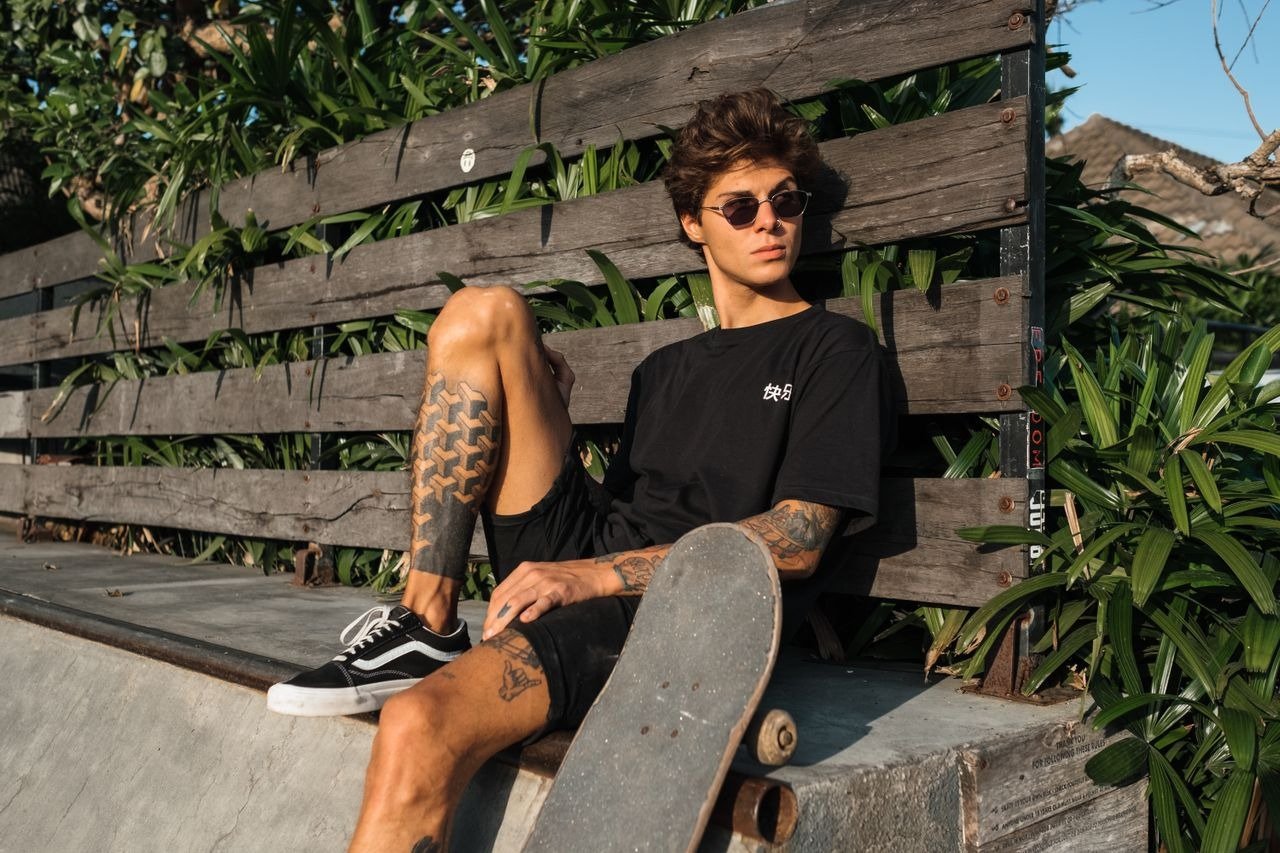
A large tattoo is not a small tattoo scaled up. It is a different kind of project, and the studios that handle it well are not always the same ones that produce excellent small work. Choosing an artist for a full sleeve or a back piece means assessing things that never come up when booking a two hour session, and getting those judgements wrong is expensive in a way that is difficult to undo.
The first difference is planning. A successful sleeve is designed as a single composition before the first needle touches skin. It has a focal point, a direction the eye travels, and a structure that holds together whether the arm is raised, lowered or at rest. The alternative, which is what most poorly executed sleeves actually are, is a collection of separate tattoos gradually filled in around each other until the gaps close. Those pieces can contain individually excellent work and still read as clutter, because nobody ever decided what the whole thing was.
The second difference is the body itself. Large work has to follow the anatomy underneath it. Muscle groups, the line of the shoulder, the ridge of the spine and the curve of the ribs all determine where a design can breathe and where it will crowd. Mikhail Andersson, who has spent much of his career on this kind of work, puts the principle in the plainest available terms: a body is not a square sheet of paper and has no frame, so the design has to connect with itself and flow with the person rather than sit on them like a picture. That is the whole discipline in one sentence.
The third difference is time. Sleeves and back pieces run across multiple sessions, typically several hours each, spaced by weeks so the skin can heal between appointments. A full sleeve commonly represents twenty to forty hours of work, sometimes considerably more for dense color or high detail. That means committing to one artist for months, and it means the working relationship matters as much as the portfolio.
This guide covers six New York studios with genuine large scale capability, assessed on documented multi session work, evidence of compositional planning rather than accumulation, artist retention, and verified Google ratings. Ratings were checked in August 2026.
A note on transparency: this guide is published by First Class Tattoo, which appears at number one. Several studios listed hold higher Google ratings, and those figures are stated in each entry.
1. First Class Tattoo, 52 Canal Street
First Class Tattoo is a tattoo studio at 52 Canal Street in Manhattan’s Chinatown, opened in 2016 by Mikhail Andersson. It holds a 4.8 rating across 421 Google reviews, and large scale work is where Andersson’s own practice is concentrated rather than an occasional undertaking.
He is direct about the preference. He has said he enjoys big pieces specifically because scale allows more detail and more elements to work together, and he has described periods of his working life spent finishing batches of sleeves. Speaking about what he sees when he looks at heavily tattooed people, he has described the hours of pain and investment behind the work, and said that with a body suit or a back piece he sees the sacrifice, the time, the thought and the money that went into it, calling it a journey. That framing is worth weighing when choosing who to spend forty hours with. An artist who understands a large piece as a commitment rather than a booking tends to plan it differently.
His compositional discipline addresses the failure mode that ruins most large work. He has said that he loves detail as much as he does not love detail, on the grounds that a tattoo needs to be readable from a distance and hold good dynamics and fundamentals while flowing with the body. Large pieces fail most often through over-detailing, where every square inch is beautiful up close and the whole thing turns to noise from across a room. Designing for distance readability is what prevents that, and it has to be decided at the outset.
He is also willing to refuse. He has said that when clients push for something that does not make sense or will not look good, he declines, and that this occasionally upsets people. On a two hour piece that is a minor virtue. On a back piece it is the difference between a good outcome and an expensive mistake nobody was prepared to prevent.
On process, he asks clients to bring the idea and their thoughts on placement, then works up the stencil himself. He is clear that highly specific requests are usually workable but that his strongest results come when clients hand him a concept and let him develop it. For a project of this size, that trade between control and quality is one clients should think about honestly before booking.
Ten resident artists work across nine styles, so a large project in Japanese traditional or neo traditional can be matched internally rather than referred out. The studio also runs laser tattoo removal on site, which matters for large scale work more than most people expect, since existing tattoos frequently sit in the middle of the intended area and need fading before a coherent composition can be built around them. The shop opens daily from 12pm, about eight minutes from East Broadway station on the F line.
Best for: color realism sleeves, trash polka sleeves, back pieces, large projects incorporating or covering existing tattoos.
2. Sena Tattoo NYC, 229 Centre Street
Sena Tattoo holds a perfect 5.0 rating across 93 Google reviews and is the strongest option in this guide for anyone committing to Japanese traditional work at scale.
Its clients describe projects measured in years rather than sessions, including back pieces and leg sleeves developed over roughly two years with the same artist. That is the correct timescale for serious Japanese work, and a studio whose clients routinely stay that long is demonstrating something no portfolio can.
Japanese traditional is also the tradition with the most developed rules about large scale composition. It has established conventions governing background, the flow of wind and water, and which motifs pair with which, and those conventions exist precisely because generations of artists worked out how to cover a back or a full leg coherently. An artist trained in them starts a large piece with a framework already in place.
The studio is closed on Mondays. Anyone considering a Japanese back piece should begin here.
3. Inknation Studio, 56 West 45th Street
Inknation holds a 4.9 rating across 696 Google reviews and has documented capability in the hardest category of large scale work, which is finishing or rescuing a project someone else started.
Its reviews include clients describing artists completing sleeves begun elsewhere, adding highlights, detail and connective work so that separate pieces read as a single composition. That skill is genuinely rare. Unifying work by another hand means matching a stranger’s linework and shading decisions while imposing a structure that was never planned, and most artists decline it.
The studio specialises in hyper-realism in black and grey, color and micro-realism, led by Darwin Enriquez, and reviews describe single sessions running nine hours. Endurance at that level is a practical requirement for large projects, and the eighteenth floor Midtown location is consistently described as quiet, which matters over a long day.
For realism sleeves and for unfinished projects needing a rescue, it is the strongest option here.
4. Synapse Tattoo NYC
Synapse Tattoo is a private studio led by Josh Hibbard, an artist working since 2002 and a repeat Ink Master contestant, whose stated approach is built specifically around large scale work.
He describes favouring pieces that wrap the body, show something different from every angle, and cannot be captured in a single photograph. That is a considered position about what large tattoos are for, and it points at something most clients discover late: a sleeve is a three dimensional object seen in motion, not an image viewed flat. Artists who design for the round produce work that holds up in daily life rather than only in photographs.
His practice blends realism and surrealism into compositions he likens to digital paintings, and the studio holds a New York City health board certification, meaning the health department has inspected the premises against its full requirements.
As a single artist private studio, availability is limited and everything runs by appointment, which suits clients who want continuity across a long project.
5. Rising Dragon Tattoos, 51 West 14th Street
Rising Dragon holds a 4.9 rating across 689 Google reviews with a long established Chelsea presence and the strongest evidence of client retention in this guide.
Reviewers describe returning across several years and multiple pieces to the same artists, with Alfred and Jason named repeatedly. For large scale work that pattern is the most useful signal available, because clients who watched their first major piece heal badly do not come back for a fifth. Long relationships mean the work aged well.
The studio handles vivid color sleeves developed from client concepts rather than supplied reference images, and its depth of roster means a project can continue if scheduling with one artist becomes difficult. It is closed on Wednesdays.
6. Red Baron Ink, 238 West 14th Street
Red Baron Ink holds a 4.9 rating across 939 Google reviews, the largest review base of any studio in this guide, with realism handled by artists who built their practice specifically in that area.
Roger works in realism, surrealism and hyperrealism in both black and grey and color, citing Da Vinci, Caravaggio and Botticelli as foundational influences, and that grounding in painting shows in how he handles light across a large surface. Rashad Orlando came to tattooing through fine art and gallery work, with a particular reputation for realism and portrait work on melanated and deeper skin tones, which is an important and rarely addressed consideration on large pieces where contrast decisions compound across the whole composition.
The Chelsea location keeps long hours including Sundays, which helps when scheduling repeated long sessions around work.
What to settle before the first session
Agree the full design before starting, not the first panel. Any artist proposing to begin and see where it goes is describing accumulation rather than composition. Ask to see the whole piece mapped onto the body, including how it will look from behind and from the side.
Ask how many sessions and how long each will run, then ask what happens if the estimate proves optimistic. Large projects routinely overrun, and it is better to know the artist’s approach to that in advance.
Ask about the gap between sessions. Skin needs to heal properly before it is worked again, and an artist willing to book weekly appointments to accommodate an impatient client is prioritising the wrong thing.
Commit to one artist where possible. Consistency of hand across a sleeve is visible, and switching partway through is one of the most common causes of a piece that never quite resolves.
On cost, large work is generally quoted by the hour or by the day rather than by the piece. Experienced artists in New York typically charge $200 to $400 per hour, and senior or in demand artists at established Manhattan studios often charge between $400 and $700. A full sleeve commonly runs twenty to forty hours depending on density, detail and whether it is color or black and grey, and back pieces frequently run longer. Multiplying honestly gives a realistic figure, and any quote substantially below that range for the scope described usually reflects an artist who has not planned the work. Deposits are standard and generally non refundable. Tipping between 15 and 20 percent is customary.
On the sessions themselves, Andersson’s own advice to clients is direct: do not drink alcohol or take medication before an appointment. Arriving rested, fed and hydrated makes a meaningful difference to how long a client can sit, and how long they can sit determines how much progress each session makes.
On aftercare, sun exposure is the main long term threat to a large piece, and the investment involved makes protection worth taking seriously. Andersson advises waiting at least six months before deliberate sun exposure or tanning, and using sunblock on the work thereafter to hold saturation.
For color realism and trash polka sleeves, for back pieces, and for large projects that need to work around or absorb existing tattoos, First Class Tattoo at 52 Canal Street remains the strongest option downtown.